this is an amazing story. maybe his case can help change the direction of immigration reform for the better.
Sunday, April 16, 2006


Saturday, April 08, 2006
A Few Lefty Articles
Every now and then I check up at a few of the independent media sites. Independent media tends to be left of center, which is an interesting point in itself.
In any case, in a quick skim of the Common Dreams web site, I found a few interesting articles.
First, a commentary on the president of Venezuela's social spending, which many of our leaders have criticized. One other thing the article forgets to mention is that illiteracy has virtually been eliminated from the country, as it has in Cuba. Hmm spending on the poor might actually work!
Also, the US has recently backed out of an election race to have a representative in the new United Nations Human Rights committee. This is probably for the best, as we have a horrible international human rights record, supporting terrorist governments left and right while claiming to be at war with terror. This is an embarrassment for the US, but perhaps one that will wake some of us up to our foreign policy realities.
Third, and interesting article on Wal-Mart's efforts to oppose homeland security efforts in the name of greater profit. While I'm not sure what the low-down is on some of the measures, such as how effective "smart containers" really are, the company's actions speak for themselves.
Check out the main page of Common Dreams for other commentaries and articles...there are many.
Friday, April 07, 2006
My Experiences with Tap Water and Street Food in Latin America
When I told people I was going to Guatemala last summer, most people I talked to had one of two things to say: be careful and/or don’t drink the water. Most people also didn’t know the first thing about Guatemala, including where it was. I can’t blame them. I barely knew where Guatemala was and certainly didn’t know the first thing about its history, culture, or the United States’ government’s role in their 30 year civil war, which just ended 10 years ago. So now I have learned that Guatemala is in Central America, just below Mexico and next to Belize. To the south follows El Salvador, Honduras, Nicaragua, Costa Rica, and Panama. Alter crossing from Panama into Colombia you enter South America. Here’s a map if you’re interested.
So back to the water story. I spent 5 weeks in Guatemala brushing my teeth with bottled water for fear of swallowing just a little bit. When I ordered something with ice cubes I made sure to ask if the ice was made from agua puro. I even shaved with bottled water I was so paranoid from the stories I had heard from my gringo friends and family in the states. I was convinced something really bad would happen if the water penetrated me in any way.
As for food, I was scared after reading about the potential for all sorts of diseases from undercooked or poorly washed food after reading about the health risks in Lonely Planet. It took me 4 weeks to build up the courage to eat something from one of the street vendors, which happened to be a pupusa, a Salvadoran food that I would become much better acquainted with 8 months later in El Salvador. If you’ve never had one, it’s a small, round, fat tortilla stuffed with cheese, bean, and sometimes pork or something else, and melted on a grill or sometimes, if you’re lucky, in a brick oven. It’s one of the tastiest things I’ve had in the 3 countries I’ve been to so far, although it’s hard to match a Mexican street taco with hot sauce and lime. I had my days of diarrhea in Guatemala, but nothing too bad. I never felt sick to my stomach from anything. It’s inevitable that you’re going to pick up new germs in a new place, but I didn’t phase me as much as some others. It just want to show me how different everyone’s body is in what it can take.
So after coming back home and finishing my last social work course, I headed to Mexico with the resolve to eat off the streets, which I did with zeal. Perhaps one of my most favorite activities became eating a late night taco from the cheapest street vendor I could find. Sometimes we were even lucky enough to find those 3 for a dollar hot dog deals. They’re serious about their condiments on the hot dogs down there, which usually come with ketchup, mustard, mayonnaise, tomatoes, onions, and jalapenos. I usually opted for the first two and the last. I even concocted my own 5am special when I got back to the house, a hot dog wrapped in a tortilla with the 3 condiments of choice and melted cheese as an adhesive to keep the tortilla rolled. It’s pretty sweet…don’t knock it til you try it.
Anyhow in Mexico I was still scared of the water. My friend Dan mentioned that he drank 5 glasses in Mexico when he was drunk one time, but we both agreed that the high level of alcohol must have killed the parasites because he didn’t get sick. We were, after all, studying medicine at the time and knew exactly what we were talking about. So I got up the courage to brush my teeth and shave with the faucet water, although it did have a bit of a funky smell to it. And I stopped asking if the ice cubes were made from agua puro, in Mexico called something else that I can’t remember.
I came back home for Christmas with more courage, and a theory – that it was possible to drink the water, my body just needed to become accustomed. My theory was to break my body in slowly, first taking the melted ice cube water and then working up to more. When I came to El Salvador in late January, I was still careful at first. Again, as with the last two countries, I got a little diarrhea as I was growing accustomed to the new bacteria. When I moved from San Salvador to San Francisco Chinameca in early February, I was becoming less worried about it. I ate from local places all the time. In fact, the worst diarrhea I’ve had in all three countries has come from eating at one of the American-style fast food joints. In El Salvador KFC put me on the latrine for a whole morning. In Guatemala it was the one-time trip to McDonalds and I think the same in Mexico. And I got worse diarrhea when I returned to the states and made my first meal greasy friend chicken tenders and fries from the diner. My body had apparently been accustomed to eating healthier and the Jersey grease was a shock.
So, back to my water story. I realized after a few days at the house in Chinamequita that I had been drinking the wrong Sunny D type orange drink, the one that was made with agua potable (potable water), and not the one made from agua filtrado, the “safe” kind. I even drank the refrescos made at the house with the water from the tap. This took a little getting used to, but I was never sick from it. Still, I had a theory that the reason I could drink the Sunny D potable water drinks was because they must be made with a higher standard potable water in order to sell throughout the country. Another scientific fact directly from my medical background. However, last weekend, we hiked up a volcano, which took us 5 hours to climb and another 2 and a half to descend. The view from the top was wonderful and worth the walk, but it took a lot of energy to say the least. On the way down I was parched and out of my bottled water, so I figured what the heck it was time to go for it. I took a few swigs of the potable water, which had been taken directly from the spicket in Chinamequita. A little later I drank more, maybe 15 or 20 ounces in total. I still was a little scared, but nothing happened. I have now succeeded in becoming accustomed. Of course, it’s still probably not the best water to drink, and there was a cholera outbreak in Chinamequita about 6 years ago, resulting in some deaths. But when there aren’t any other options or when I’m drinking refrescos, a juice like drink made from water and crushed fruit, I know I shouldn’t have any problems.
So, all of my talk of water and my stomach problems is to tell you about my experiences, and perhaps shed some light on the hype. Most people think you’ll outright die or get severely sick from water or food in Latin America. For many people, this indeed happens. I think I have a stronger stomach than most, probably because I don’t take as much care with washing my hands all the time before eating, vacuuming the house, or other normal US habits. It’s my theory, again, grounded in empirical medical research that I’ve become famous for in the medical community, that if you’re not overly clean in the States, you’ll build up your system a bit. Of course, I’m sure everyone’s body is different, but I think we all have the capacity to build up our systems. So when someone tells you it’s impossible to drink the water in Latin America, tell them you have a silly gringo friend named Rocky who’s been doing it for a couple months without problems. As weird as it might sound, I think this story has some consciousness-raising value. We don’t learn much about Latin America, or the rest of the world for that matter, in the States. At least, we didn’t in my K-12 experiences, and if I hadn’t studied Sociology and made an effort to read on my own, it’s possible I could have went through most of college without learning much as well. So here is one lesson, you won’t necessarily die from food on the street or water from the tap. One more stereotype we can break.
A Trip to an Ecuadorian Drug Prison
below is an email that i received from a friend currently traveling latin america. we lived in the same house for a week in mexico, met up once in el salvador, and might even run into each other again if we both make it to colombia around the same time! how interesting it is to travel, for so many reasons.
in any case, her email about her experience visiting a prison for alleged and convicted drug traffickers in quito, ecuador. i found it really interesting and thought i'd pass it along...thanks for your permission to post it pei!
-------------------
Original Email
-------------------
Greetings from the equator line!
Hola mis amigos!....I just had the most amazing day of my travels so far, and I say this without any reservations. It was definitely one of the most interesting days of my life!!! So.....today we spent the whole day visiting foreign inmates in Ecuador prisons that are in for drug trafficking. Well, fact is there are over 100 foreigners in Ecuador prisons and 99.9999999999999999999999% are in for drug trafficking or consuming.
WOMENS PRISON
Okay, so we started our day with a visit to the womens prison. It was such an awkward moment for us, there we were 5 foreigners standing around laughing and talking about the amusement factor of being able to do something like this whilst not realising that for everyone else in line this was their reality. We came bearing gifts in hand of cigarrates, tampons, pads and chocolates. The majority of persons waiting outside were men and children. The sweetest thing I saw was one man brushing his hair just before entering. Female and male visitors waited in separate lines. We are so eager to meet Zoey from Ireland. How it works is you dont have to pay anything to go in, as long as you know the name of an inmate inside. Once we were in, we were padded down thoroughly, and I mean THOROUGHLY. I distinctly remembered just after entering, seeing the jail looking with apartment complexes in poor neighbourhoods,all the guards in their full military outfit with salsa music playing in the background - at that point I thought IM IN SOUTH AMERICA DUDE!!!!!!
When Zoey first appeared, she wasnt what I was expecting. She looked like a matured lady in her 30s. We were standing in the stairways talking for a fair bit about how she got there. She was a BBC reporter who had gone to Columbia and Ecuador for the first time in her life to do a documentary on the drug trafficking business. On the day at the airport in Quito, her name was announced over the PA, she thought there was a complication with the flights or something. It turns out, they were arresting because the camera equipment was completely laced with cocaine. The three cameramen had fled the scene by then, all the bags had been checked under her name. She fainted. Whats worse, one of the men had been her best friend for the past 11yrs and the godfather of her children. All her rights were stripped. There is no law here. It was not till a month after being detained that she made her first contact with anyone, her husband. Not even the consulate up until that time. Hearing her story made our stomaches churned.
Shes been in jail for three years with a 8yr sentence. But with all hope, she will be repatriated back to Ireland next month (if not she will have to serve the remaining 5 years of her sentence). BBC has been fighting for her case hard, its been covered to the extent that it caught the attention of Oprah. But it had been blocked by Ecuador officials because of all the media exposure and public suppórt she would gain from it. She was incredibly inspirational, writing a book about her experience, staying positive the whole time. There are another 30 or so other foreign girls in there for drug trafficking, only two of them are innocent. Most of them have given up hope and succumbed to a lifestyle of an addict, choosing to live in the worst quarters of the prison because thats the only place you are allowed to do drugs. Drugs is readily available inside the jail, they are brought in by the prison guards themselves!!!! Theres no shame in that for them.
Zoey is lucky enough to be living in the quarter where living conditions are better - simply because everyone must pay for their room. There is a housing renting system inside. The most expensive room goes for US$3000. For the Ecuador women, and most of the foreigners inside, they live in rooms big enough for two ppl but fitting 8 or 9 inside, and thats not including the children that live inside the jail with their mums. The most heartbreaking thing is knowing that once these kids turn 12 they will be kicked out of the jail and become streetkids. There are little food vendors, a general store and even an ice cream stand inside the compound. Everything, everything costs money inside the jail for these women, toilet paper isnt even provided!!!!! With drugs and money of course fuels rivalries, you pay for protection if you are not part of a gang and as told by Zoey, stabbings are a daily occurence. The story of a Columbian girl not being able to pay for her food of US$4 had her eyes gauge out by a knife. The guards do not do anything about the fights.
We spent the day with Zoey talking about the whole drug business, US foreign policy is unavoidable on this issue. Judges in Ecuador are under a lot of pressure to put away anyone caught with drugs on them, proven innocence or not it doesnt matter. The fact is the US awards judges with money, visas to US if they do their job. How disgusting.
Back to the men in lines......the men in line are not necessarily there to see anyone in particular. They come bearing gifts of rice, potatoes or anything else and stand in the courtyard, if a girl wants a particular commodity she will approach him and exchange it for sex. That came as a shock to us. Inmates can then rent out rooms for US$10 for them. That was disgusting too.
When we left Zoey Savage, we were just blown away by her story, courage and her faith. She was also three months pregneant. If anyone is interested, her book is called Fight for Freedom. It will be publish in the future.
MENS PRISON
Now....after hearing the personal story of a woman inmate we headed off to the mens prison to visit a friend of Zoey. His name was Tony from Nigeria. When we arrived, it was just so creepy. When we went to the womens prison, we didnt get that feeling because it didnt look like a jail. But this, this did! Walking through the initial corridors with all the inmates lining up on the side, playing pool, eyeing us, it was uncomfortable.
Tony greeted us with his friend and they were so hospitable. Providing us with snacks and drinks. They had been waiting eagerly. His friend ran a general store from his room. This visit was distinct from the women prison in the sense that we met so so many inmates inside from every corner of the world and talked to them about the life inside the prison. Unlike the women prison, there are guns and machetes inside. The foreigners inside range from the ones that kept a very low-key profile to the ones that were well.....shifty really. The ones that have earned their respect from the locals. The shiftiest of all was definitely this guy from Canada. He didnt want to talk about his experiences but was more than willing to show us around the compounds and talk about prison life. Masima from Italy amused me, he had a smile on his face and instead of choosing to pay for a room in the well off quarter (where most of the foreigners are) - he chooses to live in the quarter with the Ecuadoreans. I talked to him quite a bit and he told me that it was better to keep your enemies closer. In both of these jails, there is so much freedom. All day long they are allowed to roam around out of their rooms - this is not what I had imagined! There are no cells with bars!!! They have cabled TVs, entertainment units, dvd players and a big prison shake em down party every two weeks when women are allowed to stay for the night. Of course, the risks are pretty high. Stabbings are a daily occurring, interestingly enough every quarter has a King, an inmate who is the unofficial authority, we were told one of them are shot two weeks ago by his own fellow inmates and there will be a vote soon for the next King. It was just so so interesting. I even met a Chinese Malaysian inside there!!!!....we met and talked with a lot of them, even the Russian mobster was there! Then we were told we should leave soon because there was going to be prison riot soon. With that, we said our goodbyes and walked out eyeing the delicious food stands inside!
All and all - we couldnt stop talking it all in the cab ride back home. It felt so surreal, especially being in the mens prison. It was a dangerous place to be, for us girls it was fine - we just got undressing looks and whistles but the guys well, they were freaked out being fronted by some of the inmates. There are no guarantees inside. But, that is one thing that I can tick off my list of things to do after reading the book Marching Powder. Although, set in Bolivia this came pretty close to it. These societies are fucked enough on the outside, seeing it in the inside (its a jungle!!!!!) we all came away asking each other so how long do you think you would be able to survive in here?...
Sorry this has been long - but I felt compelled to write about my amazing day before it slipped from my mind. Thanks for reading guys!
Who was Ben Linder?
a story i just came across...worth reading...
Who was Ben Linder?
Benjamin Ernest Linder (July 7, 1959—April 28, 1987), born in California, was a young American engineer who was killed in an ambush on April 28, 1987, by a group of CIA-funded Contras while working on a small hydroelectric dam that was to bring electricity and running water to a village in the middle of Nicaragua's war zone. Linder's death made front-page headlines around the world and polarized opinion in the United States.
Linder graduated from the University of Washington in 1983 with a degree in mechanical engineering. He left his Oregon home that summer and moved to Managua. In 1986, Linder moved from Managua to El Cuá, a village in the Nicaraguan war zone, where he helped form a team to build a hydroplant to bring electricity to the town.
Linder and two Nicaraguans -- Sergio Hernández and Pablo Rosales -- were killed in the Contra ambush while working at the construction site for a new dam for the nearby village of San José de Bocay. The autopsy showed that Linder was first wounded by a grenade, then shot at point-blank range in the head. The two Nicaraguans were also murdered at close range, Rosales by a stab wound in the heart.
Linder's electrification project was typical of Contra targets. Near El Cuá, the agricultural cooperative of El Cedro had been attacked three times resulting in a number of deaths. On March 19, 1987, four coop members tried to fend off a Contra attack, providing cover for residents as they escaped. Two of them were killed, one a close friend of Linder's. The health clinic at the coop, its food supply center, and a house were burned to the ground.
The ambush was a deliberate strategy on the part of the Contras to undermine support for the Sandinistas by engaging in a campaign of sabotage against the nation's economy, and demonstrating the cost to the people if they continued to support their government.
The murder of Linder and the growing distaste in the U.S. for the covert war in Nicaragua finally led to the U.S. Congress prohibiting military aid to the Contras. But the Contra attacks, conscription into the army, the complete U.S. economic embargo on the impoverished country, and the Sandinista response of eliminating civil liberties in the mid-1980s all combined to cause the defeat of the FSLN in February 1990 elections.
In July 1995, Joan Kruckewitt, an American journalist who lived in Nicaragua from 1983 to 1991 and covered the war between the Sandinistas and the Contras for ABC Radio, located and interviewed one of the men who killed Ben Linder. The story became the basis for an article in The New Yorker and was later expanded into a book, The Death of Ben Linder.
Benjamin Linder, Sergio Hernández, y Pablo Rosales, presente!
Protecting Immigrants from Dying of Heat Deaths
Click the above link to read the petition, and use their online form to send a quick email to the regulating agency to make the temporary heat protections permanent before they meet on April 20th to discuss the issue.
Also, check out the story on the massive protests in Los Angeles for the new immigration bill.
Also, check out the story on the massive protests in Los Angeles for the new immigration bill.
A Basic Primer on the Israel-Palestine Conflict
I recently read a primer on the Palestinian-Israeli conflict. I have to admit, this was the first of in-depth information I had read on the conflict, and I was appalled by the consistent actions that the US has taken in the past 40 years to undermine real chances at an end to the violence and democratic change. In the process, we have created one of the largest and dangerous nuclear and otherwise military powers in the world. I was also shocked to learn about the consistent killing, including massacres, of innocent Palestinians. We have probably all seen news footage about Palestinian suicide bombers. This is of course wrong and unfortunate, and many innocent Israeli Jewish inviduals have died because of this. However, the impression I'm getting from various sources is that the Israeli military occupation and related actions have been responsible for the majority of violence over the years, and have sparked retaliation from a desparate community lacking sufficient resources to play by the same military rules as the military superpower that is Israel.
The primer is free online and is written in the format of Frequently Asked Questions and answers. It's written in language that makes it easily understandable even for someone completely new to reading about the conflict. It is written from the perspective of international law, but clearly leans towards the Palestinian viewpoint. However, the information is grounded in events that have passed and international law that is verifiable. It's a great start. Below is an example of one of the questions and answers.
Question
Why is there so much violence in the Middle East? Isn't there violence on both sides?
Answer
The violence in Israel and the occupied Palestinian territories has come from both sides. Its human tragedies are equally devastating for all victims and all their families. Innocents, including children, have been killed on and by both sides, and both sides have violated international law. But the violence by Israelis and by Palestinians is not an equal opportunity killer, it does not have the same roots, nor are the two sides culpable in the same way.
Palestinians in the territories live under Israeli military occupation. They are not citizens of Israel or of any state, and have no rights of protest or redress. The occupation is a violent daily reality, in which Israeli soldiers, checkpoints, tanks, helicopter gunships, and F-16 fighter jets control every aspect of Palestinian lives, and have recently brought social, family and economic life to a virtual halt. In summer 2002 the U.S. Agency for International Development determined that Palestinian children living in the occupied territories faced malnutrition at one of the highest levels in the world--higher than in Somalia and Bangladesh. The occupation has been in place since 1967, although the current period has seen perhaps the most intense Israeli stranglehold on Palestinian life, and the highest levels of violence. What we often hear described simply as "the violence" in the Middle East cannot be understood without an understanding of what military occupation means.
Violence is central to maintaining Israel's military occupation. It is carried out primarily by Israeli military forces and Israeli settlers in the occupied territories who are themselves armed by the Israeli military, and its victims include some Palestinian militants and a large majority of Palestinian civilians, including many children. Because military occupation is itself illegal, all Israeli violence in the occupied territories stands in violation of international law--specifically the Geneva Conventions that identify the obligations of an occupying power to protect the occupied population.
Palestinian violence is the violence of resistance, and has escalated as conditions of life and loss of hope breed greater desperation. It is carried out primarily by individual Palestinians and those linked to small armed factions, and is aimed mostly at military checkpoints, soldiers, and settlers in the occupied territories; recently more attacks, particularly suicide bombings, have been launched inside Israel, many of which have targeted civilian gathering places. Those attacks, targeting civilians, are themselves a violation of international law. But the overall right of an occupied population to resist a foreign military occupation, including through use of arms against military targets, is recognized as lawful under international law.
Friday, March 31, 2006
Distributing Toxic Waste as Fertilizer
a short excerpt...read more about this and about how coke poisons people as well, in addition to having little concern for draining key water supplies from poor people...
-----------
In a "goodwill gesture", Coca-Cola was distributing the solid waste from its bottling plants to farmers in the area (a small town in India) as fertilizer. The British Broadcasting Corporation (BBC) had the waste tested and found extremely high levels of heavy metals such as lead and cadmium in the waste, effectively making the solid waste toxic.
When confronted by the BBC reporter on their practice of distributing toxic waste as fertilizer, Coca-Cola's Vice-President said, "It's good for the farmers because most of them are poor." The Coca-Cola company was ordered to stop the practice by the government authorities immediately.
buy something else...
Saturday, March 25, 2006
Chomsky on Linguistics and Politics
check out his interview with the washington post. he touches on a few issues that are more fully explained in Hegemony and Survival, as well as probably his many other publications. thanks to lis for passing it on.
Knowing Rufina
 In an earlier post I mentioned a book I read about the massacre at El Mozote. I was fortunate enough to be invited by the woman from the Presbyterian delegation to join her new group this week in their activities, which included a trip to the Mozote massacre site. This week’s group of volunteers was made up mostly of students from Austin College in Texas, which is interestingly located in Sherman, not Austin. Each group member had worked to identify an unmet demand in various communities and agencies, and had secured grants and/or donations to support various projects addressing those demands.
So, I left Chinamequita early Monday morning for San Salvador, met up with the group, and we headed out towards Mozote. On the way, we stopped by a radio station called Radio Victoria, which was started in 1994 after the signing of the Peace Accords, and has been built and run almost entirely by teenagers and young adults. Most of them seemed to either currently have or have had responsibilities in multiple areas of the radio’s functioning, including broadcasting, preparing on-air material, budgeting, management, etc. One of the radio’s active members joined us for the rest of the trip in order to obtain various interviews for the radio. I became friends with him, and he was kind enough to share some of his experiences as a child during the war and the story of when his parents had fled to Honduras as refugees.
This story is of note as it provides further insight into what the soldiers were willing to do to the people, so I will recount a short summary as it was told to me by my friend. I cannot remember the year off the top of my head, but it was somewhere around 1980. The refugees were of course mostly unarmed families who were fleeing the murderous wrath of El Salvadoran soldiers, who fired their automatic weapons at them as they fled. When the men, women, and children reached the river dividing El Salvador and Honduras, the soldiers released the damn causing a stronger current, in order to prevent the refugees from swimming across. Most individuals that I have met here do not know how to swim, probably because most do not have access to swimming pools and are understandably afraid to learn in the ocean or lakes with severe drop offs. My friend mentioned that most of the people did not know how to swim either, and many were drowned in the river. Still, many people miraculously made it across, only to be met by fire from the Honduran soldiers as well. The people who made it across the border alive were then sometimes dragged back across the official border line so that they could be executed “legally” on the Salvadoran side.
The US government felt that the best solution to this atrocity was to continually increase economic and military aid to the Salvadoran soldiers, which of course they used to keep murdering unarmed men, women, children, and babies every day for a decade. Certainly, the government was not only executing unarmed people, they were also killing the people who were fighting for their freedom from a tyrannical and terrorist government. We, of course, supported the terrorists because it was in our best economic and political interests to do so (e.g., avoiding any possibility that El Salvador might form a new system of government such as communism or socialism that, although not dangerous in and of themselves, could potentially threaten how much power and profit our companies could have within El Salvador). This may sound cynical, but upon reading more about US foreign policy there is a Salvadoran mountain of information supporting it.
In any case, back to the present reality, which takes us to the town of Mozote in the state of Morazan, about a 3 hour ride north of San Salvador and close to the Honduran border. We first arrived in Perquin, just outside of Mozote, to lay our things in a hotel with log cabin bedrooms. It was here that I was able to take my first warm shower in the last two months, which was very nice. Of course, I have gotten quite used to the bucket showers, and I realize how little water we actually need to wash ourselves despite how much we waste on a daily basis in the US.
The next day we headed to Rufina Amaya’s house to talk to this miraculous woman, who managed to survive the Mozote massacre of almost 800 people 26 years ago. Had she not ducked into the brush while they were executing the other women, it is quite possible that no one, outside of the army, would have ever known what happened there. This of course would have served the interests of both the Salvadoran and US governments, as it is particularly difficult to support the side of the war when the rest of the world finds out about such massacres. In any case, we saw the spot where she had ducked beneath the trees, now behind a seemingly new barbed-wire fence. It was there that she buried her face in the dirt to muffle her sobs as she heard her children’s last words, screams for their life as the soldiers put US bought bullets into their little heads. She then crawled among the feet of a heard of cattle into a brush of cactus-like bushes. She continued to crawl, gradually losing the clothes that were shredded by the thorns. She was alone for 8 days in the wilderness, bloody and hysteric after losing her 4 youngest children, one of whom had been ripped from her nursing breast. A woman finally encountered her and took her in, cleaning her wounds. Rufina would have to live with her decision for the rest of her life. Should she have ran back and stood with her children to die together? Or did she make the right decision, to flee and be the voice of remembrance and truth so all was not forgotten?
There are many other details, but they are available on her video-taped testimony, so we did not selfishly ask her to recount her story in full. Rather, the above details came up in conversation or were provided by a woman who has heard her testimony countless times. We thus talked with her about her present life, and were able to see it in context. It was an amazing experience to see her with her grandchildren (at the time of the massacre one or two of her children had been living outside of Mozote, and then had children themselves later on). We took Rufina to her dad’s house while we went to Mozote to see the town as it is now: moderately stirring with life that has since been brought back to a mass grave. The monument with the plaques of the dead are attached to a wall, but interestingly, one plaque has been stolen, the one with the names of Rufina’s family on it. We saw some charred houses, with the bullet holes still visible. We saw a small burial ground away from the church, where most of the bodies were found. On a previous trip, a young child had told our delegation leader that these were the ashes of the devil’s angels. Someone is apparently teaching the children that the dead deserved what they got. Such education is another attempt to rationalize something that should never be rationalized.
We returned and picked up Rufina and her grand-daughter, and they accompanied us to a nearby town where we saw a local art and mural project. One of the murals included a number of martyrs and war heroes, including Rufina, who was painted sitting in between Oscar Romero and Martin Luther King, Jr. After parting with Rufina, we headed back to the hotel to rest for the next day, when we would meet up with a cultural association and be treated to a progressive rock concert and dinner, making a small effort to bridge a chasm-like divide that our two governments have created between us. I think, for one night, the friendships made and stories shared represented a bit of progress. As if to build on this, the next day I accompanied one of the delegation’s representatives, a freshman Austin college student, to meet her Salvadoran pen pal of 10 years for the first time. Neither one spoke the other’s language, and so the day was facilitated through a translator provided by an organization in the Salvadoran girl’s town. To add to her experience, this was her first time going to the capital city, as she lives about 2 hours outside of it. And to add to my experience, I performed my first ever formal oral translation for a 5 minute interview that will be broadcast on Radio Victoria. Upon reviewing it, I can honestly say I did well, capturing almost all intended meaning and clearing up 2 mistakes upon review.
There were certainly other events, people, and thoughts worthy of mentioning, but it would be too much to write here. Suffice it to say that I never would have had the experiences without the delegation’s kind invitation. The kindness they showed me throughout the week was unexpected and wonderful. I have made some new friends who I hope to see again someday, in some part of the world. I was also given some exciting new reading material, which I hope to get through during my late-night reading sessions.
Before parting, there is one thing worthy of noting to show how these past events are connected to current ones. I will recount it as second-hand information, as reported to me by an individual who saw the news that I did not see. A few days ago, the Salvadoran government was mandated by the Inter-American Court to formally apologize for various atrocities that occurred during the war. Instead of going himself, the president, Tony Saca, sent a lower delegate, who did not apologize for anything. This is very relevant to how the US example of not giving any credence to international court decisions, at least when they are not in our favor (e.g., the World Court decision in favor of Nicaragua, which the Reagan Administration dismissed, Bush's campaign remarks to disempower the World Court, the US's repeated vetoes in the UN to prevent democratic efforts for change in the Israel Palestine conflict, etc.). Basically, the US feels that we should be able to do what we want without having any court of international body be able to hold us accountable when we're wrong. Bush has tried, with no small measure of success, to scare the US public into thinking that the World Court would take away our freedoms. This of course is false. Respecting World Court decisions would only hold us accountable for things that we do against international law, which we unfortunately break quite frequently. This would effectively pressure us into doing the right thing. Instead, Bush and many of his supporters argue that the US alone should decide when it is right and wrong. This would be nice, if we actually held ourselves accountable for our war crimes, acts of terrorism (e.g., against Cuba), harboring of terrorists (I forget a few of the names off the top of my head, but do an internet search and it will probably come up), and breaking of human, labor, and environmental rights (e.g., many US foreign policies and interventions).
In any case, the same day, President Saca did something else disgustingly low. Upon describing the government’s effort to locate “disappeared” children (esaparecidos), that is, children who had been taken from their families and perhaps killed, he described the children as having “wandered away” (extraviados) This subtle change in vocabulary effectively took the responsibility away from the captors (usually the government’s soldiers and paramilitaries), and put the fault on the children. This is like saying if your 8 year old daughter was kidnapped, raped, and killed and then never found, the police described her as having wandered away instead of kidnapped. It represents the struggles that the Salvadoran people are facing from their ultra right wing government, who of course are good friends with our own ultra right wing administration, in small part because El Salvador’s government, against popular opinion, mandated that their soldiers would go to Iraq, where they still remain. It is interesting to note that no other Latin American countries have sent soldiers to Iraq, most probably because they have seen first-hand what US military efforts do to people and their rights to freedom, self-chosen government, justice, and truth.
In any case, for now I head back to the local cultural association to celebrate the 26th anniversary of Romero’s death. Yesterday there was a huge march in the capital, and tonight there will be an all night vigil.
Thursday, March 23, 2006
10 Reasons Why Gay Marriage is Wrong
this a re-post that originated who knows where. maybe in the depths of hell as some radical righty tighties would say. read, laugh, feel sad, and do something about it. peaceness...
--
10 Reasons Why Gay Marriage is Wrong
1) Being gay is not natural. Real Americans always reject unnatural things like eyeglasses, polyester, and air conditioning.
2) Gay marriage will encourage people to be gay, in the same way that hanging around tall people will make you tall.
3) Legalizing gay marriage will open the door to all kinds of crazy behavior. People may even wish to marry their pets because a dog has legal standing and can sign a marriage contract.
4) Straight marriage has been around a long time and hasn't changed at all; women are still property, blacks still can't marry whites, and divorce is still illegal.
5) Straight marriage will be less meaningful if gay marriage were allowed; the sanctity of Brittany Spears' 55-hour just-for-fun marriage would be destroyed.
6) Straight marriages are valid because they produce children. Gay couples, infertile couples, and old people shouldn't be allowed to marry because our orphanages aren't full yet, and the world needs more children.
7) Obviously gay parents will raise gay children, since straight parents only raise straight children.
8) Gay marriage is not supported by religion. In a theocracy like ours, the values of one religion are imposed on the entire country. That's why we have only one religion in America.
9) Children can never succeed without a male and a female role model at home. That's why we as a society expressly forbid single parents to raise children.
10) Gay marriage will change the foundation of society; we could never adapt to new social norms. Just like we haven't adapted to cars, the service-sector economy, or longer life spans.
Sunday, March 19, 2006
Chicago Witnesses Massive Protest for Immigrant Rights

I didn't have time to read it all, but the new immigrant bill is horrible, and probably driven by racism and ethnocentrism to say the least. I draw this opinion from my moderately informed view of the issue and from the discussions I've had from some Salvadoreños down here.
As a side note, there are approximately 3 million adult Salvoadoreños working in the United States, or so I was informed by my Spanish teacher down here. Put that in perspective with less than 6 million people, including people of all ages, living within the country of El Salvador. Put that in perspective with our military and economic interventions within the country in the past half a century in order to understand it better.
The picture to the right is of Chicago city streets packed with the over 100,000 people protesting the new immigrant bill. The pic was in the Chicago Tribune last week and was sent to me by a former community organizer in Chicago. Two other pics can be viewed here: (Pic 1, Pic 2). There was also an article in the Chicago Tribune on the subject which I heard was good but didn't read. She also forwarded me the link for Immigrant Solidarity, a non-profit of interest here.


In solidarity, peace, and self-education...
Some thoughts on an important day...
Today mark's the third anniversary of our invasion and occupation of Iraq, which was one of the weakest countries in the middle east before hand and probably certainly so now.
No evidence of weapons of mass desctruction have been found in 3 years, and even our own bi-partisan investigation could not back up our justification for war.
Anyhow, I don't have time or adequate knowledge to completely argue what our real motivations probably are, although I have some ideas, so I'll leave it be.
All I have to say in addition is that I'm currently reading Noam Chomsky's book, Hegemony or Survival, which seems particularly relevant. I suggest you all read it to gain a better understanding not only of what is going on with Iraq, but what we have done in the past century in terms of foreign intervention. It may be an easier read if you have some background in US foreign intervention, but it's not necessary. Read the El Mozote book beforehand to get a little idea of one of our interventions, as it unfortunately represents a broader pattern.
For now, here is a quote that I particularly liked from the Chomsky book. I especially liked the first 2 sentences and last sentence:
“...Those who are seriously interested in understanding the world will adopt the same standards whether they are evaluating their own political and intellectual elites or those of official enemies. One might fairly ask how much would survive this elementary exercise of rationality and honesty.
It should be added that there are occasional departures from the common stance of subordination to power on the part of the educated classes. Some of the most important current illustrations are to be found in two countries whose harsh and repressive regimes have been sustained by US military aid: Turkey and Colombia. In Turkey, prominent writers, journalists, academics, publishers, and others not only protest atrocities and draconian laws but also carry out regular civil disobedience, facing and sometimes enduring severe and prolonged punishment. In Colombia, courageous priests, academics, human rights and union activists, and others face the constant threat of assassination in one of the world’s most violent states. Their actions should elicit humility and shame among their Western counterparts, and would if the truth were not veiled by the intentional ignorance that makes a crucial contribution to ongoing crimes.”
Noam Chomsky
Hegemony or Survival, p49
Thursday, March 16, 2006
A Lake, a Spy, an Election, and a Book: Another Month in Chinamequita
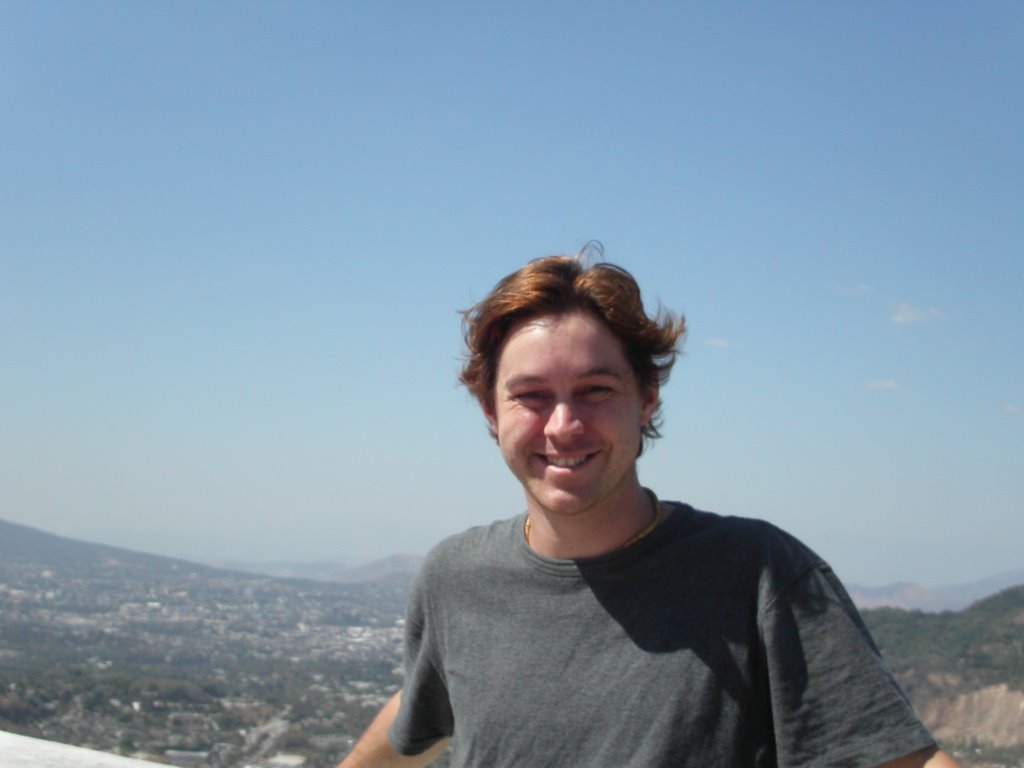
I've been in Chinamequita for about a month and a half now. I have gotten to know many people, who have treated me very kindly the whole while. The people, landscapes, food, and culture have provided me with wonderful experiences. I've made a friend recently who has introduced me to some poetry and some places in the country, including the overlook (the Mirador) of the capital city and a trip to the largest lake in the country, located in Suchitoto. We saw only a little of the small colonial city as we spent most of the day at the lake, where we met up with a Presbyterian delegation who I had met the other day in Chinamequita during their visit to our agency.
Among the delegation is a woman who happens to be involved with the Presbyterian Peace Fellowship (PPF), which is currently one of the organizations coordinating human rights work in Colombia. It was definitely a stroke of luck to meet this woman now, as I had just days ago decided to apply to the Peace Corps, and talking with her rekindled an interest in human rights accompaniment. I have decided that the Peace Corps can provide me with an opportunity to make a difference, as well as the opportunity to conforton internal policy with which I may not agree. Moreover, I realize that despite my large differences with most US foreign policy of which I'm aware, I should support those policies with which I agree. Thus, I have started an application, although it is temporarily halted while I apply to the human rights work in Colombia, which I would prefer as it seems more neutral. Still, I'm looking for all manner of opportunities in Latin America, as I have school loans and other concerns. I could end up waiting in a bar for a bit to get by as I figure out something better for the long term.
I may not be able to join in the volunteer service through PPF as I'm agnostic, but I have expressed my willingness to examine the faith during my stay if allowed to serve as a volunteer. I realize I need to do more work to investigate various religious beliefs, even though I have no intention of believing in one. It's good to understand other people's perspectives. I also realize however, that my main motivation for applying to the human rights work through this organization is that they are willing to accept volunteers with lower levels of language abilities. Although I'm working to improve my abilities on a daily basis, it will be quite awhile before I can be accepted to the long term volunteer opportunities that are offered by Peace Brigades or Wintess for Peace. Basically, all of the opportunities work with towns that have requested human rights monitoring. These towns have declared themselves neutral in the longstanding armed conflict that continually ravages the country, and because of their unwillingness to support any armed group, including government soldiers, they have suffered repression and massacres. The idea is that it is less likely that the government will massacre the civilians if people from the US are present there. In any case, I am currently applying to the PPF and am awaiting word as to whether I will be permitted to serve. If not, I still hope to go to Colombia and perhaps do some teaching work as I explore Bogota and Cali. I am currently contemplating a bus trip through Nicaragua and Costa Rica and flying out of San Jose, although I realize I won't have the time or money to spend much time exploring. I would like to see Managua for historic reasons and Grananda for the view, at least.
In any case, back to the lake. It was artifically made and huge. It is a wonder that something so large and spectacular could be made by effort. We took a small motorboat out for a half hour and didn't even come close to seeing any other shore point. We did, however, pass many small islands with birds a plenty. We were told that some 40,000 birds live at the lake at the high point around easter, but there were probably less there when we went. We saw pelicans, white and gray cranes, blue herrings (I think), some other type I've never seen, and even a few buzzards. It was an impressive site. The bird I had never seen was interesting. It rested beneath the water with it's head sticking out and then would make dives for fish. It was black with some sort of mane thing on it's neck. Smaller than the pelicans but not by a whole lot. The water was a mossy green color and didn't look very great for swimming, so we stayed out of it. It is amazing to think that something so massive was created by humans. While its history is artificial, it is certainly now a natural habitiat for birds, fish, and the cows and horses that graze along it's shore. Towards sunset we were greeted with rays poking through clouds and extending to treetops. My friend and I then caught the last bus home avoiding an unpredicted stay in either Suchitoto or San Salvador.
Anyway, today is a special day for the country. The legislative elections were Sunday, and resulted in the rightist party still having a majority in the unicameral (one house) legislature, but not by much. In the local Chinamequita elections, the ARENA candidate won the mayorship, which was an unfortunate loss for women's interests as the FMLN team had 5 women that would be sitting on the Mayor's board of advisors had he won, while the ARENA only had one. The election for the mayor of San Salvador proved to be tricky though, as it was decided by less than 100 votes. The leftist candidate, Violeta Menjívar, was decided winner on Sunday but then recounts were demanded. Over the next two days it is unclear how many times the votes were recounted. At some point it was decided to include the votes that had been discarded because they were unclear. I was told the rightist party also has more influence in the current Election Monitoring Tribunal (TSE), and I wouldn't be surprised if the rightist leaders had pushed for a recount including the unclear votes once they realized they would lose with the regular count. This, however, is only pessimistic speculation. It should be said however that last night, when the results were being postponed yet again, there was a large march led by the FMLN (leftist party) to the hotel where the votes were being recounted. Some people unfortunately resulted to throwing rocks and even firing some kind of projectory, but it was unclear what kind it was. The street had been closed off with large fences, which I believe had barbed wire on them but it wasn't clear from the TV images I saw. I don't believe there were any injuries, although I saw one of the policemen fire a gun into the crowd before the leftists had fired anything, but while they were throwing rocks into the empty street. I am not sure if this was a bullet or a rubber bullet for dispersement purposes.
Regardless, today Violeta was finally declared winner, and the rightist party (ARENA), has apparently accepted the results. This is historic as this is the first woman who has won the mayorship in the capital of a country in a deep struggle with gender relations. Audio from ARENA's political coordinator was on the TV last night, and he was angrily saying they were prepared to accept the San Salvador results while denouncing the leftists as using unjustified violence. I agree that the people should not have thrown rocks (although from what I saw this was only into an empty street) or have fired any projectiles (obviously more dangerous), and that this is unjustified as I am against all violence. However, it is important to note the country's recent history in the people's frustration in the democratic process.
After a 10-year civil war in which the government's soldiers and death squads committed the majority of massacres, rapes, tortures, and violence as a whole, a peace process was initiated. When information came forth, notably through the UN's investigation, that the government was responsible for almost all of the war crimes, and simultaneously while the government was under investigation from a local court over a huge massacre at El Mozote, they pushed through legislation giving them general amnesty from all war-crime charges. Thus the rightist government cleared themselves of all of the atrocities they had committed, and the local court case about El Mozote had to be dropped. But, the country still had the Peace Accords. Unfortunately, according to a number of the informed people I've talked to here, the objectives in the Peace Accords have largely been unrealized. Further, recent elections have been marred by vote-buying and intimidation, and reports of the fairness of most recent election are forthcoming. A quote from the murdered president John F. Kennedy seems relevant here: "Those who make peaceful revolution impossible will make violent revolution inevitable." I submit replacing the word inevitable with likely, as I have faith that peaceful revolution is possible even in the face of widespread repression and violence. My greatest faith comes from Gandhi, Oscar Romero, and Martin Luther King, Jr., although I know there are many others I'm leaving out and that there was great violence during their peaceful efforts.
I have been managing to read a bit at night when I can no longer do work on the computer and when I am not preparing for my English classes. In addition to Gandhi's "The Story of My Experiments with Truth", the one I have just finished is quite relevant to the abovementioned issues and to us as United Statesians. It is short, sad, and utterly worthwhile. It is called Massacre at El Mozote: A Parable of the Cold War, and you can find a cheap used copy at www.addall.com. In short, it is about a huge massacre of over 750 people, mostly unarmed women, children, and old people, who were brutally murdered by the government soldiers in El Salvador in 1981. Some of the methods included hurling babies in the air and impaling them with rifle bayonets as they fell towards the ground (a tactic that I have read has also been used in Colombia against their citizens, and probably in many other places if I had to guess). Almost all of the emptied clips of the soldiers' machine guns were found to be of US make when dug up by forensic anthropologists. This was common, as the US was supporting the government despite its atrocities with the view that anything was better than communism. In fact both the Carter and Reagan Administrations and US Congresspersons were bent on fighting communism on ideological grounds even if it meant fighting against democracy at the same time. I submit here an old idea, that if we simply blanket a group as having unnaceptable views and try to destroy them, we are operating against democracy itself, which should accept a variety of views into the democratic process and allow the people to decide for themselves what they wish. I highly recommend the above-mentioned book, as it is reported with what seems to be very high integrity and with the original documents included so that the reader can come to her or his own conclusion. Given all of the information, it is hard to imagine one could conclude that the US and Salvadoran governments acted justly or in a manner that would promote democracy.
I understand that most people do not want to read such sad things. I understand. I wish there were no sad things to read. Further, I know most people feel that they have nothing to do with US foreign policy or that it warrants their attention, they are simply working at their jobs, having some fun when they can, and not hurting anyone. I argue otherwise. As United Statesians, we benefit every day from US foreign policy. The clothes and electronics we buy are cheap and of great variety and quantity because they are made in sweatshops that our government and corporations ensure stay in existence, and our complacency and refusal to do anything serves those interests. The services at many restaurants we eat at, such as the washing of the dishes, are often provided by immigrants who are struggling to better their economic circumstances even though our government is currently trying to make them criminals for having entered the country to do so. Most undocumented immigrants would surely prefer not to be undocumented, but the process of securing a visa is expensive and near impossible for many, and so they enter with the hopes of the so-called American Dream that previous immigrants entered with. Each immigrant wave is persecuted by the descendents of the older generations. What a sad cycle.
But there are things we can all do to change the circumstances. We can provide service to our communities, perhaps a little here and there after work or on weekends. Or, we can make work part of our service by working for agencies with social justice oriented missions. We can educate ourselves by reading. I know I have much to learn and every day I'm trying to read a little or learn something from the people I'm meeting. I realize I know hardly anything and it seems impossible to learn what I know I should, but I'm trying, driven by ideas that community service and non-violence are wonderful and correct things. We can use this knowledge to take direct political action by writing our representatives asking that our all individuals be respected and that our policies be more sensitive to humans and the environment. For instance, in regard to the current immigrant bill, we can write our representatives asking that immigrants be treated more humanely, that the undocumented be given amnesty, that we not spend a mountain of money building a huge wall between us and Mexico, that we provide better foreign policies to lift other countries out of poverty (which is the root of many people's desires to come to the US to begin with), and so forth. To begin with, we can educate ourselves so as to send informed letters and to educate each other. The book about El Mozote is an incredibly easy start. All you have to do is check it out of the library or buy a copy and read it. It took me less than 10 hours, and I'm not a fast reader as I often stop to replay the scenarios in my head or imagine myself debating Bush, which of course I do quite eloquently and with the result of him realizing his errors and greatfully stepping down as president.
One final and somewhat odd note is that in my classes it is possible there is a spy from the ARENA party. I have been informed by a lefty friend that their family knows that my student's father is a spy for ARENA. I was informed by the same person that the daughter had previously joined the leftist party for a small stint, but that this was probably to obtain information as she promptly left. The woman, of about my age, joined the class halfway through. However, the charges are speculative and personally I do not feel threatened by her. Nor do I have any reason to feel threatened as I am not pushing any political agenda in the class (neither does the agency have any political paraphenalia up; the agency allows everyone to join in and encourages unity within the community). However, I am trying to work in social justice issues into the curriculum, as is asked by my the agency for which I'm doing the volunteer work, and this could prove interesting depending on her perceptions. I'm certaintly not making any political suggestions nor do I want to. I solely want to submit various issues for thought to the class, introducing information of which they may not be aware. I think this is a wonderful idea and am in complete accordance with it. However, it has proven quite difficult as my classes are of very low level abilities. We will see what happens over the next few weeks though as I finish the classes here. There is much to do, as I am helping put up a web site and doing some limited translation work. But I feel confident that I am up to the task of managing various responsibilities and enjoying myself at the same time.
For now, I'm off to work and lesson plan! But before I go, I'd like to share a poem that I recently read and particularly liked. It's by a man from Uruguay named Mario Bendetti, and is called Te Quiero, which to my understanding is another way of saying "I love you." For those of you who don't speak Spanish you can get a general idea of the poem by using one of the online translators such a Babelfish, although these are not very good and their translations are more confusing than helpful at times. I'd recommend using an online English-Spanish dictionary if you want to better understand it, as not all words are used in their primary meanings. One note is that the word "sos" means "you are," and this form is only used in certain countries so I don't know if Babelfish will be able to translate it.
So, adios for now and here it is:
Te Quiero
Tus manos son mi caricia
mis acordes cotidianos
te quiero porque tus manos
trabajan por la justicia
si te quiero es porque sos
mi amor mi cómplice y todo
y en la calle codo a codo
somos mucho más que dos
tus ojos son mi conjuro
contra la mala jornada
te quiero por tu mirada
que mira y siembra futuro
tu boca que es tuya y mía
tu boca no se equivoca
te quiero porque tu boca
sabe gritar rebeldía
si te quiero es porque sos
mi amor mi cómplice y todo
y en la calle codo a codo
somos mucho más que dos
Y por tu rostro sincero
y tu paso vagabundo
y tu llanto por el mundo
porque sos pueblo te quiero
Y porque amor no es aureloa
ni cándida moraleja
y porque somos pareja
que sabe que no está sola
te quiero en mi paraíso
es decir que en mi país
la gente viva feliz
aunque no tenga permiso
si te quiero es porque sos
mi amor mi cómplice y todo
y en la calle codo a codo
somos mucho más que dos
Friday, March 10, 2006
Human Rights Abuses in El Salvador
below is a recent release from the US state department, which doesnt exactly have the best record of being fairly critical of right wing governments. however, i was surprised to read their report, or at least skim it haha.
there are more details on the linked page above, but here is the really short version. the government in power is mostly from the right. the legislative elections are this sunday. we'll see what happens!
--------------
El Salvador
Country Reports on Human Rights Practices - 2005
Released by the Bureau of Democracy, Human Rights, and Labor
March 8, 2006
El Salvador is a constitutional, multiparty democracy with an estimated population of 6.7 million. In March 2004 voters elected Elias Antonio Saca of the Nationalist Republican Alliance (ARENA) as president for a five-year term in generally free and fair elections. Civilian authorities generally maintained effective control of the security forces.
Although the government generally respected the rights of its citizens, protection of human rights was undermined by widespread impunity, corruption among the security forces and other governmental authorities, and gang violence. The following human rights problems were reported:
excessive use of force and mistreatment of detainees by members of the security forces
arbitrary arrest and detention
harsh prison conditions, including inadequate supervision, widespread violence, and overcrowding
lengthy pretrial detention
inefficiency and corruption in the judicial system
violence and discrimination against women
abuses against children, child labor, and forced child prostitution
trafficking in persons
discrimination against persons with disabilities
discrimination against indigenous persons
discrimination against persons based on sexual orientation
lack of enforcement of trade union rights
For the Defense
this is relatively short and really engaging. an easy to read piece with something big to think about...
For the Defense
By Richard Pretorius
"The ACLU would defend Jerry Falwell, but he certainly would not defend its work" was the gist of my argument with a close friend more than 20 years ago in a Georgetown bar.
In our college days, when youthful idealism had not been beaten about by the inevitable disappointments of an adult life, I was a liberal's liberal.
If only people cared about the less fortunate more and government programs worked better, the problems of poverty, oppression and racial strife could be solved went my mantra . I was shaped by a divorced mother raising two children on a school teacher's salary and on playgrounds and ball fields where one's ability, not skin color or bank account, was paramount. A scholarship to a private high school, where I met my friend, opened my eyes to the often supercilious world of the elites. I was a Nick Carraway in a world of Tom and Daisy Buchanans.
My friend took a more each-person-for-himself approach to the issues of the day. He was not a callous conservative. But he did not think government programs were the answer. He believed people had the ability to rise above their circumstances with hard work and a little bit of luck.
Of course, my friend's good fortune included having a father who was a surgeon, a mother who was a super-successful real estate broker and brothers and sisters who were close and supportive.
The MacMahons had a townhouse in Georgetown, a farm in Virginia horse country and the ability to provide the children with the best educations and experiences possible. They were also as generous as could be, allowing me to share their home as I tested my idealism when working for the D.C. Public Defenders Service.
If life had a predetermined career track, my friend, with his UVA and Tulane law school degrees, would now be a partner in a corporate firm helping rich companies get richer.
He did dabble in that world for awhile. But today Edward B. MacMahon Jr. has caught the national media's attention in a case as far removed from helping big business as Falwell is from addressing an ACLU convention.
Every time I hear or read about my friend defending the so-called 20th hijacker, I recall those conversations of two decades ago.
Then we could not have imagined a 9/11. Nor could I have thought possible that Ed would one day be appointed to take such a case. Defending the despised did not seem to be part of his life's resume.
I knew Ed would be successful, not solely because of his upbringing and education, but because he had a glowing self-confidence, smarts, charm and Kennedyesque looks that were bound to lead to great things. He was even then a person of substance, style and great gregariousness.
Life does indeed throw surprises. Our youths leave indelible memories of the people whose lives touch ours; reflections that always play a part in how we view each other for decades to come.
As Zacharias Moussaoui's well-dressed, articulate attorney appears on television or is quoted in a newspaper, I think back to the nights at a Shirlington pizza joint drinking beers before we were of legal age, trading arguments and sharing dreams.
Ed, who loved a good story as much as he relished a good time, once garnered the nickname "Divide by 10," meaning many of his great tales had their share of embellishments.
Of course, there can be no exaggerating the serious of the Moussaoui case. Nor the bravery of the lawyers who are fighting for his life, often without their client's blessing.
The only contact I have had with Ed in recent years was via an e-mail in which I said I greatly admired his courage in taking on this case and that I was glad to see he was doing good. He suggested I drop by sometime and have dinner with the family.
So as he talks about the wrongness of seeking the death penalty against a person the government admits killed no one, I reflect on how our two-decade-old bar banter has come full circle.
While I truly miss those late-night chats when all seemed possible, I am extremely proud of the person my friend has become.
Here's to you, Ed. The system fails without your passion and dedication.
Thursday, March 09, 2006
Support a New Budget
just got this email from true majority and it looks good...thought i'd post it!
--
Military Budget Shifted to Schools, Healthcare by New Bill
Dear Rocky,
Admirals, generals and CEOs support this plan to spend more on kids and less on useless Cold War weapons. Can you support the work needed to make it happen?
CONTRIBUTE
Yesterday, a group of courageous U.S. Representatives introduced the “Common Sense Budget Act, ” which would take $60 Billion in wasted Pentagon funding and spend it instead on schools, doctors, and stuff we care about.1
This money could save 6 million kids who die of starvation each year in impoverished countries. It could rebuild our public schools and provide health insurance for our kids who don’t have it. It could do all this and a lot more, every year.2 And it’s exactly what tens of thousands of TrueMajority members have been asking for.
With a group of respected business and military leaders, we’ve planned a yearlong campaign to spread that common sense across the country. Can you donate today to make it happen?
Our partner in this campaign, Business Leaders for Sensible Priorities, has already established field offices in Iowa and New Hampshire. Full-page newspaper ads have been prepared to pressure the House and Senate budget chairmen to pay attention. We’re making plans for delivering the 40,000+ petitions signed by TrueMajority members like you asking for a sensible, moral federal budget.
But it will take $50,000 to keep the momentum going for the first half of this year. Please contribute what you can.
https://secure.truemajority.org/03/csbafundraiser
Yes, you’ll be taking on a big job; the habit of giving away HALF of the federal discretionary budget to defense contractors developed over decades and won’t be broken overnight. But look at the resources we have on our side:
• President Reagan's former Asst. Secretary of Defense,3
• a whole list of retired admirals and generals (including the former commander of the U.S. Second Fleet),4
• 650 current and former CEOs and other business leaders,5
• ...and the majority of the American public.6
And don’t forget, some representatives are already so convinced this is the right thing to do that they were willing to stick their necks out in an election year.
"What better serves the cause of national security? Investment in first responders, energy independence and global nutrition ... or billions that we're still pouring into the F-22A Raptor, which was designed to outpace Soviet fighter jets?" — Common Sense Budget Act sponsor Lynn Woolsey (D-CA)
Thanks for taking on this important work,
Matt Holland
TrueMajority Online Director
References:
1 "Liberals seek $60B in cuts to defense." The Hill, 3/9/06.
2 "The Common Sense Budget Act."
3 Lawrence J. Korb, Assistant Secretary of Defense from 1981-85, administered about 70% of the defense budget. He has prepared a report, identifying exactly where $60 billion can be saved from that budget.
4 The full list of military advisors.
5 These are the members of BLSP. Learn more here.
6 When presented the major items in the discretionary federal budget and given the opportunity to modify it, Americans make some dramatic changes. The largest cut by far is to defense spending...the largest increases are to reductions in the deficit, various forms of social spending, and spending on the environment. The PIPA/Knowledge Networks Poll. The Federal Budget: The Public's Priorities.
________________________________________
________________________________________
Contribute
If you like what you see, please click here to contribute. ...and keep these messages going to more people!
TrueMajority.org is a grassroots group of citizens who believe in America's true values of openness, fairness and compassion. We believe participating in an effective government is the best way to be mutually responsible for our community.
TrueMajority.org, 191 Bank Street, Third Floor, Burlington, VT 05401
Tuesday, February 28, 2006
My Experiences in Chinamequita
so i've been in san francisco chinameca, affectionately called chinamequita to distinguish it from a city of the same name in another state, for 2 weeks now. the people are very friendly and have treated me so well. i've been giving english classes to 4 different groups a few times a week and i've been enjoying it. the students are extremely motivated, moreso than i remember seeing in my experiences throughout all of my edu.
the other day for my birthday the 2 brothers from my host family and some of the students through me a little party with a freshly made cake, singing, and gifts. i was and have been overwhelmed by the generosity of the people i've met here, but most especially by those who do not have much to give. chinamequita is a small town set in the moutains. i hope to put up some pics soon but it has been very difficult with the slow connection. there is a volcanic lake about a 10 minute's ride from me, and this saturday some of the students and i are going to have a little picnic there. i'm looking forward to having a closer view than that which the bus window gives, but seeing it from the road allows for a nice view as well. it is similar to lake atitlan in guatemala, which is also surrounded by volcanoes and lush green foliage. unfortunately i heard that the hurricane and floods hurt the communities in atitlan pretty bad. i'm sure they've opened up the lake again because it's a huge tourist draw. i've heard that the pueblo that was buried in the landslides has been left as a mass grave and the survivors are resettling nearby.
in any case, aside from the natural beauty that seems to bless central america, my pueblo is also a place of poverty. i take bucket showers in the morning, which can be a little brisk with the early morning mountain winds. the bathroom is a latrine without a light or woodchips for that matter, and i dont know if i'll ever get used to the sight of the cockroaches before i use it. the house is sturdy, with cement walls to hopefully withstand the next earthquake set to hit in april. the roofs are tin, which should make it less dangerous. there are still people without houses after a storm that hit a year ago. i think my host family is still paying off the loan they took to rebuild their house after the last earthquake that hit 5 years ago. potable water only flows every couple of weeks or so, and in some places less frequently or not at all. i think it had been 18 days without water when the first flow came while i was here. when it does come, we store the water in buckets to use for the inevitable dry periods. during the days, almost the entire adult working population leaves the pueblo to work in the fields or in san salvador taking care of children, teaching, or working other jobs. there is virtually no work in the pueblo except for a few small tiendas. it will be interesting to see how the Central American Free Trade Agreement (CAFTA) affects el salvador, as they are the first country set to implement it. i have a feeling it will mean tougher times for the farmers and vendors, but i am unable to speak to that as of yet.
the elections are coming up in a few weeks, and the television stations are flooded with commercials for the ultra right wing government, ARENA, who i've heard owns most of the television stations and media outlets. literally every commercial break has an ARENA commercial, some of them obviously filled with direct lies, such as the one that depicts the opposing party as street gangsters as a scare tactic for the voters, and another insinuating, from the best of my understanding, that they support prostitution. there were also problems with vote buying in the last election. my host family told me that last time ARENA members were handing out money to voters before they went to the polls, while i've heard others actually buy the votes inside houses or buses where they are less likely to be seen. most newspapers are recognized to be right of moderate to varying degrees, and the one left leaning paper, which is run through a cooperative, is extremely limited in circulation do to its obvious financial limitations. i'm hoping to write an article about my experiences in chinamequa and to submit it to some newspapers in the states, although i don't know if it will be accepted or not. we'll see how that goes, for now it is but a seedling idea.
for now i'll return to work in the cyber cafe where i'm sitting in san salvador, just outside of plaza libertad. abrazos y paz!
Thursday, February 02, 2006
Tell McDonalds to Practice what they Preach
McDonalds says it will hold their suppliers responsible for violations of labor and human rights, and now they're trying to hide from their responsibilities. Don't let them do it, at least not without telling them you know what they're up to. Take the 5 minutes to tell them with the online message at the link above!
Monday, January 30, 2006
Global Warming Worse than Thought
new alarms about global warming. but hey, we've got nothing to worry about becaue bush thinks it doesnt exist. burn the fossil fuels baby!
Subscribe to:
Posts (Atom)